
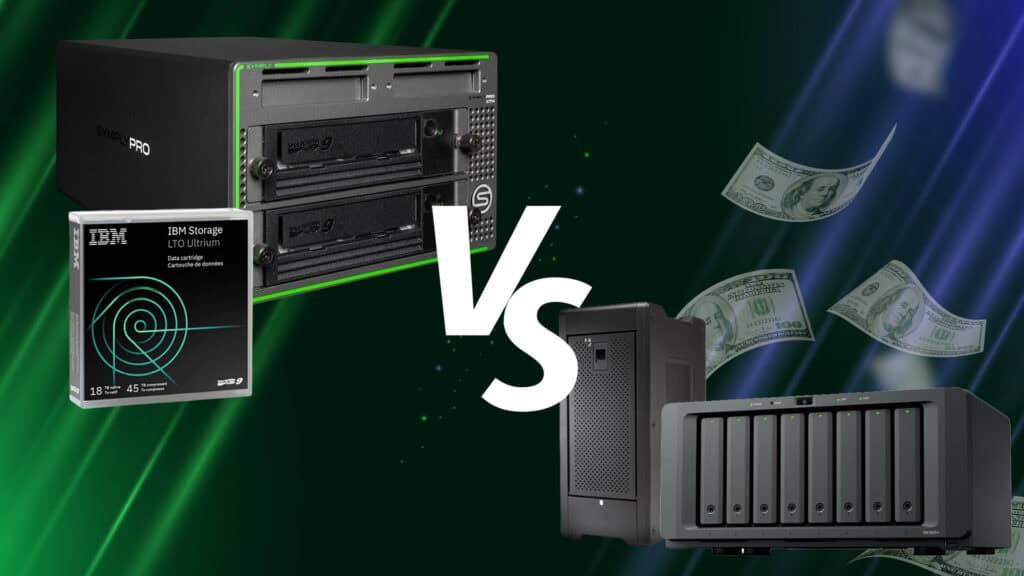
Hard drive prices have jumped anywhere from 65% to nearly 100% in the past several months — some models have essentially doubled — as Western Digital, Seagate and Toshiba funnel most of their 2026 production to AI data centers. It’s a genuinely shocking swing for hardware that used to be the boring, predictable line item in a storage budget, and there’s no relief in sight: supply agreements already lock in this shortage through until 2029. DAS RAID and NAS RAID both run on those same drives, so if you’ve priced either lately, you’ve felt it — which has a lot of people taking a second look at LTO tape.
Tape hasn’t been immune either, with prices rising through spring and summer 2026 and another bump expected before the year’s out. The newest LTO-10 cartridges run roughly double the per-TB cost of the previous generation. But that’s nowhere near hard disk’s climb — even at LTO-10 pricing, tape still undercuts a comparable high-capacity hard drive, and mainstream LTO-9 remains far cheaper still. So here’s the obvious question: if tape is still that much cheaper, why buy DAS RAID or NAS RAID at all?
It’s a fair question, and it deserves a straight answer. Here’s what each format actually does well, where the cost-per-TB number stops telling the whole story, what the drive cost doesn’t tell you either, and how to figure out the right mix for what you’re actually doing with your data.
LTO Tape Wins on More Than Cost
Let’s give tape its due, because the reputation is earned. LTO cartridges cost a fraction of the per-TB price of a hard drive — a gap that’s only getting wider as drive prices climb. They’re rated for a 30-year shelf life, versus roughly 4 to 6 years for a hard drive in regular use. And the error rate is staggering: LTO tape is roughly 10,000 times more reliable than a spinning disk, and about 1,000 times more reliable than an SSD.
Then there’s security. Once a cartridge is written and ejected from the drive, it’s completely offline. There’s no network connection to compromise, nothing for ransomware to reach, nothing to encrypt or hold hostage. Sitting on a shelf, it simply can’t be hacked.
Power draw tells a similar story. A petabyte of tape sitting in a library uses somewhere around 300 watts. That same petabyte spinning on hard disk uses roughly 3,500 watts — more than 11 times as much, every hour of every day, whether anyone’s touching the data or not.
Add it up, and it’s easy to see why tape remains the backbone of long-term archiving for studios, broadcasters, research labs, and anyone else sitting on huge volumes of data they need to keep but rarely touch
What the Cost-Per-TB Number Doesn’t Show
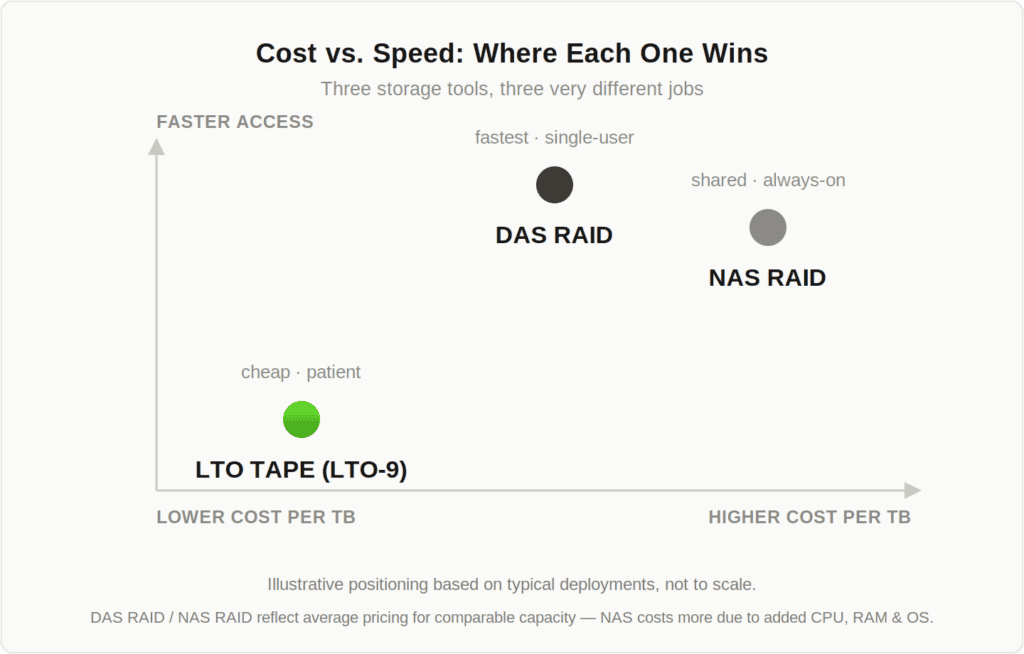
Here’s what that cost comparison leaves out: tape is a sequential medium. Data goes onto a cartridge in order, and it comes back off in order. If the file you need happens to sit two-thirds of the way through a cartridge, the drive has to wind through everything before it to get there. We’re talking minutes, not milliseconds.
And you can’t work directly off a tape. There’s no opening a project file, scrubbing through footage, or querying a database straight from a cartridge — the data has to be restored to something faster first. Tape is brilliant at holding data, but it was never meant to replace a hard drive. You need to have the right tool for the job at hand.
Think of it like a warehouse archive versus the folder on your desk. The warehouse is cheaper, more secure, and can hold vastly more — but nobody wants to walk out there every time they need a document mid-meeting.
Where DAS RAID and NAS RAID Earn Their Keep
This is exactly the gap DAS RAID and NAS RAID exist to fill.
DAS RAID is built for speed. Millisecond access, and real-time redundancy that means a single drive failure doesn’t take the whole project down with it. It’s the natural home for active editing, VFX rendering, or anything where waiting isn’t an option.
NAS RAID takes that same active storage and puts it on the network, so a whole team can reach it from wherever they’re working. Always on, always reachable, with no cartridge to dig out of a library.
That network access comes at a price: a NAS RAID unit is really its own small computer — CPU, RAM, and an OS to handle file sharing and multiple users — while a basic DAS enclosure just leans on the host computer and holds drives, which is usually cheaper. Premium DAS units built for rugged, on-location work flip that, though — hardware RAID controllers and dual connectivity carry their own cost, often matching NAS RAID.
Neither is trying to be cheap. They’re trying to be fast and available — a different job entirely, and one tape was never built for.
The Long Game Isn’t That Long Anymore
Here’s the part a cost-per-TB comparison leaves out entirely: the tape drive itself isn’t cheap. A capable LTO drive or small library runs several thousand dollars before a single cartridge goes into it — often more than an equivalent DAS RAID or NAS RAID enclosure costs on its own. Looked at as a single upfront purchase, tape can actually look like the more expensive choice.
It used to take a couple of years for tape’s higher upfront cost to pay for itself. Now, with hard drive prices skyrocketing, that same payoff happens in about a year and a half — because every additional TB of tape still costs a fraction of an additional TB of hard disk, and that gap only widens as drive prices keep climbing.
An independent 10-year total cost of ownership study by Solutions North Consulting, published by the LTO Program back in 2023, found that an all-LTO-9 archive came out 83% less costly than an equivalent all-hard-disk approach over that decade-long horizon. That figure is already a few years old, and it can only have grown since: LTO-9 pricing has stayed comparatively steady while hard drive prices climbed as much as 65 to 100% in the time since. The real gap today is almost certainly wider than 83% — and the payoff arrives faster too.
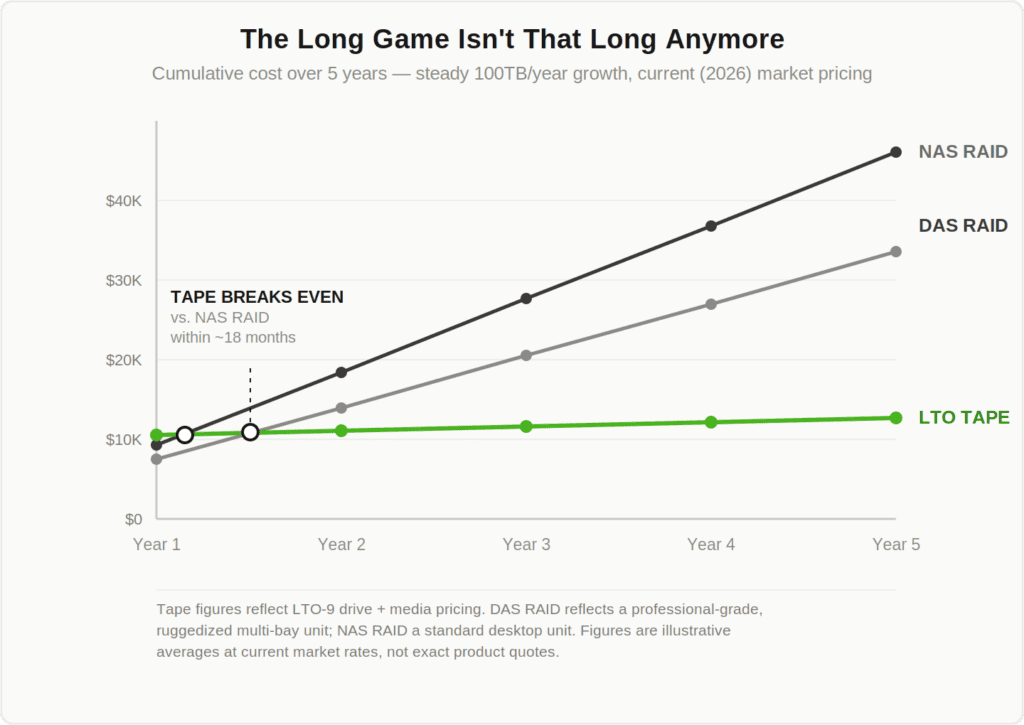
Run the numbers on a typical growing archive — say, adding 100TB a year — and current pricing makes the case even more sharply than it used to. A professional-grade, ruggedized DAS RAID unit with hardware RAID and dual high-speed connectivity carries its own premium on top of the drives inside it, and a standard NAS RAID unit isn’t far behind once its added networking and OS costs are factored in. Tape’s total cost falls below both within the first year and a half — sooner against the pricier DAS-class unit, just after against NAS RAID — and the gap only widens from there. In a scenario like this one, that can mean tens of thousands of dollars saved by year five, against either option.
That’s the part a simple cost-per-TB number misses, and it’s a faster story than it would have been two years ago: it’s not what a terabyte costs today, it’s how quickly today’s drive prices make that higher price tag pay for itself.
Cost vs. Speed: The Full Picture
| LTO Tape | DAS RAID | NAS RAID | |
|---|---|---|---|
| Cost per TB | Lowest | Higher | Highest |
| Access Speed | Minutes (sequential) | Milliseconds | Milliseconds |
| Best For | Long-term archive & disaster recovery | Active editing & real-time work | Team-wide shared access |
| Power Draw | ~0W at rest | Always-on | Always-on |
| Typical Lifespan | 30+ years | ~4–6 years | ~4–6 years |
| Offline Security | Immune once ejected | Exposed if network is compromised | Exposed if network is compromised |
The Real Answer: It Depends on Your Workflow
There’s no universal ratio of tape to DAS RAID to NAS RAID that fits every organization. The right mix depends on how much of your data is genuinely active, how large your total footprint is, and how many people need to reach it at once.
A post-production studio churning through 4K and 8K footage every day needs serious DAS RAID and NAS RAID just to function. LTO Tape has a role well before wrap, too — securing camera originals as they’re ingested and backing up work in progress along the way in case disaster strikes — and once the project wraps, it moves to tape for good.
An organization sitting on years of records — kept mainly for compliance, rarely opened again once they’re filed — doesn’t need RAID at all. What it needs is LTO tape, built to archive exactly that kind of data safely and cheaply for decades.
Compliance is worth spelling out, since it’s one of the biggest reasons any organization ends up sitting on decades of untouched data. It just means information you’re legally or contractually required to retain for a set number of years — student records, financial filings, healthcare data, employment files — whether or not anyone ever opens it again. Education, healthcare, finance, and government all have their own retention rules, and most of them run into decades, not months. That’s exactly where LTO tape shines.
With hard drive prices where they are right now, it’s worth being deliberate about what actually needs to sit on expensive active storage in the first place. The less you’re paying to keep inactive data “hot,” the further your storage budget stretches where it actually matters — and the bigger your archive gets, the more that discipline pays off.
The Bottom Line
LTO Tape wins decisively on cost — both today and even more so over time — while DAS RAID and NAS RAID win on speed and accessibility, which tape was never designed to deliver. Trying to make one do the other’s job just means fighting the format.
The right mix isn’t the same for every organization, but the pattern holds everywhere: keep what’s active fast and accessible, and let tape handle everything else — cheaply, securely, for decades. Figure out where that line sits for your data, and the “which one should I buy” question answers itself.
Not sure where that line sits for your setup? Get in touch and we’ll help you work out the numbers.
Check out our LTO Tape Portfolio here.
More about LTO Tape Technology here.